Worried about the Republic? So was Benjamin Franklin!

What can we do to keep it?
The Compass, August 2022

subscribe to the print copy- https://square.link/u/8zXudXlR

At the close of the Constitutional convention, history reports that a woman stopped Benjamin Franklin in the streets of Philadelphia and asked, “Well Mr. Franklin, what kind of government do we have?” To which Mr. Franklin replied, “A republic, madam, if you can keep it!” (James McHenry’s journal.)

What were the conditions leading up to this convention that made the writing of the Constitution possible, and what were Mr. Franklin’s concerns about being able to maintain the Republic? The answers to these two questions are critical in understanding the “spirit” of the Constitution as well as the letter of the law.

As to the first question, the people of the American colonies were perfectly prepared to accept the principles of a free government. In his book, Burdens of Freedom, Lawrence Mead wrote about the changing societal norms that took place in western Europe, which laid the foundation for a growing desire for freedom and individualism in the people.

First, Mead advocates that from the fall of the Roman empire through the enlightenment period, many governments moved away from societies of order to societies of freedom. Societies of order were characterized by absolute power and control by the rulers with little regard for the interest and advancement of their citizens. They saw people as mere pawns of servitude. While societies of freedom prioritized the agency of man and the importance of the individual. Societies of freedom protected man’s rights and liberty.

Second, Mead asserts the growth of Christian faiths and teachings of religious leaders helped to alter man’s view of himself from mere servants of the state to one of divine individuals full of possibilities—both temporal and spiritual. This paradigm shift only strengthened man’s desire to be in control of his or her life. There were secular changes as well. These changes came about over centuries. The literature of philosophers, scientists, and physicians added to the education of everyday citizens. Writers, including Locke, Aristotle, Cicero, de Montesquieu, Blackstone, and Smith, added to people’s desire for more autonomy over their own lives and they became less willing to submit to strong, central governments that were often corrupt. Many people seeking freedom found refuge in Great Britain and the Netherlands, which became a springboard for a small group who fled northern Europe for the New World on the American continent in search of greater freedom and self-government.

Third, the Puritans and Pilgrims mustered the courage to leave Europe, and found in North America, a new world sparsely populated, with ample natural resources and a land with no formal government. The principles of self-governance that the Pilgrims put into the Mayflower Compact would have a lasting impact on the future regional governments in the colonies, ultimately leading to the writing of the Declaration of Independence and the Constitution of the United States.

Thomas Jefferson captured these beautiful and politically significant concepts in the Declaration of Independence. “We hold these truths to be self-evident, that all men are created equal, that they are endowed by their Creator with certain unalienable Rights, that among these are Life, Liberty, and the pursuit of Happiness.”   

The first concept is that these rights were given by our Creator—by whatever name one wants to use. Period writings from our nation’s founders, including personal letters, show that faith in a Divine Creator, religion, and religious principles played a large role in influencing the writing of our laws. The founders did not want religion to be a litmus test for office, but they did not intend the government to be devoid of faith. They prayed often for divine guidance as they worked through the writing of the Constitution. They knew no government could write laws to cover every evil and nefarious act. They expected citizens to live under an overarching umbrella of honesty, integrity, and reverence for their Creator. 

The second concept is the right to life. Locke points out in his Second Treatise of Government, Chapter IX that if by natural law, man is free and the absolute lord of all his possessions, property, and life, it then follows that everyone can and should protect themselves from aggressive and threatening behavior on the part of another. If a man is equal to every other man and is not subserviate to any other man, it is consistent that no man has the right to terminate another’s life. To do so would be to suggest that one is greater than the other in the eyes of his Creator. Taking innocent life is a heinous crime and is severely punished in almost all modern societies.  

The third concept is liberty, which is closely related to the pursuit of happiness. The right to choose one’s direction in life is a sacred right and is essential to self-progress and joy. The protection of possessions and property is essential for a free people. John Locke, in his Second Treatise of Government, gives guidance on the subject in Chapter V. Nature provides natural resources that are held in common by all men. However, Locke pointed out, that once a man adds to any one of the gifts of nature an element of his own labor, the gift in question changes in status from “held in common” to “private property” and is no longer able to be held by another. By way of example, a tree once held in common by all men, which is felled, milled, and cut for the purpose of making shelter, cannot be possessed or taken by another without the consent of the former. The tree becomes the sole possession of the man who added his labor to the tree. This possession is now protected, in a free society, from theft or confiscation by any person or authority. All possessions and property are, by natural law, an unalienable right. To be able to increase one’s wealth is an integral part of the pursuit of happiness, because having wealth facilitates freedom and liberty. 

So, what were the conditions that lead to the convention that made the writing of the Constitution possible? First, recognizing that the God of Heaven gave us our rights and freedoms—not governments. Second, that government should protect those rights and be controlled by the people rather than government controlling people and making them subject to tyranny. Third, the terms Life, Liberty, and the Pursuit of Happiness had overarching and timeless definitions and were not just general euphemisms. Finally, the people understood that living according to a moral compass where respect for others is present, liberty and prosperity are possible. All of these were present during the founding of our country.

Now for the second question. Why was Mr. Franklin concerned about maintaining the republic? Mr. Franklin’s first concern was federal government overreach. He, along with the others, understood the natural proclivity of all men, that as soon as they gain a little power, they begin to abuse that power. The founders wrote the Constitution in such a way as to limit the powers of the federal government, and to push the powers of government down to the lowest possible levels to help counteract this tendency. The Tenth Amendment of the Bill of Rights expresses the principle that undergirds the entire plan of the Constitution: which is the federal level of government only possesses the powers expressly given to it by the people and that all other powers reside with the local and state levels. The Tenth Amendment makes sure the states keep a significant amount of power for themselves, as a safeguard to the freedoms of everyone in the new government. Federal governments that constantly seek more power and control over the people are in direct opposition to the intent of the Constitution. 

Second, the states should have sufficient power, both individually and collectively, to counter any attempt by the federal government to increase its power and control over the nation. Again, the Tenth Amendment and Federalist Paper #46 address this in detail. Most are familiar with the Tenth Amendment, giving most duties of government to the state and local governments. However, few are aware that in Federalist Paper #46, Madison clearly states that the people would give greater loyalty to their states in counteracting a grab for power by the federal government, further strengthening the intent of the Tenth Amendment. Also, present in Federalist Paper #46 is the rationale and justification for the Second Amendment, the right of the people to keep and bear arms, which is a final protection against central government abuses. 

Third, was the need for the people to elect honest and moral representatives, senators, and presidents who were conversant with the ideals of the Constitution and had an absolute desire to protect the Constitution from people with evil and nefarious designs. They should live according to the natural law of the Creator, as discussed in Locke’s Second Treaty of Government.   

Fourth, was that the average citizen must become familiar with the design, purpose, and operation of the Constitution and how it works to run the nation. Additionally, they needed to stay informed of the direction of the government at all levels to be able to thwart any attempt at abuse.

So how are we doing today? Just a few examples seem to suggest not very well. Career politicians who seem to be more interested in personal gain, which suggests a need for term limits, the 17th Amendment minimizing the voice of the states at the national debate, presidential executive orders by-passing the legislative processes, out-of-control spending by Congress, involvement in foreign wars, and failure to defend the rule of law all in opposition to the letter and spirit of the Constitution demonstrate a disturbing trend.

 Mr. Franklin was profoundly serious when he said, “If you can keep it,” and it seems we haven’t done a good job of “keeping it.”

Fellow Americans, my plea for you is to become more educated about the Constitution and teach it to your families. Vote to preserve the freedoms and rights of the Republic. Elect representatives, senators, and presidents who will support and defend the Constitution. We need to return to the original intent. We need to be accountable for our own actions. Finally, what we need most is more morality, more faith, and more reverence for our Creator. 

Long live the Republic!

Posted in August 2022, The Compass Issues 2022 | Leave a comment

What role did Enumerated Rights play in recent Supreme Court decisions?

The Compass, August 2022

subscribe to the print copy- https://square.link/u/8zXudXlR

In the hot Philadelphia summer of 1787, a unique collection of men debated how to create a new form of government, a government that would put first the rights and privileges of its citizens. At the end of the summer, most of them signed the most significant government document in the history of the world. Within a year, eleven states ratified the United States Constitution, and the other two states would follow in the next two years. Thus, a new nation arose not from tyrants and despots, but from citizens through their representatives.

Upon ratification, the Constitution became the law of the land. According to Article 1, the legislative branch was to pass laws within the limited powers granted to them. In Article 2, the founders created an executive branch to administer and enforce the laws legally passed by Congress. Article 3 provided for a judicial branch that would adjudicate laws brought before them to determine if the law was in harmony with the provisions of the Constitution. The other articles were largely procedural, but subsequent amendments enumerated specific rights for the citizens of the nation.

One of the popular criticisms of the judicial branch of government, from all segments of the political spectrum, is judicial activism. What is judicial activism? A good definition is when a court decision is rendered based on personal or political ideologies, rather than providing a constitutional basis for it.

Almost all judges and courts are, at some point, accused of activism. In particular, the Supreme Court of the United States (SCOTUS) has recently been targeted with this complaint. The most recent term was one of the most momentous in our lifetimes, with several high-profile rulings that have garnered a lot of scrutiny.

To frame the debate over the latest decisions, the ninth and tenth amendments provide context for why the SCOTUS acted as it did. The first eight amendments to the Constitution enumerate specific individual rights that the federal government is obligated to adjudicate and protect.

The ninth amendment clarifies that United States citizens have far more rights than those currently listed and that their absence in the Constitution doesn’t diminish their importance. It says: “The enumeration in the Constitution, of certain rights, shall not be construed to deny or disparage others retained by the people.”

The tenth amendment then makes clear that rights not enumerated in the Constitution are outside federal jurisdiction; they are to be relegated to the states. It says: “The powers not delegated to the United States by the Constitution, nor prohibited by it to the States, are reserved to the States respectively, or to the people.”

The Bill of Rights supports the body of the Constitution by reinforcing the concepts of limited government, checks and balances, separation of powers, and popular sovereignty. Rights not specifically enumerated were always intended to be pushed down the governmental food chain to state or local governments. In this way, our liberty is safeguarded from governmental overreach.

In summary, the Constitution not only empowers the branches of the federal government but also simultaneously imposes limitations. As the law of the land, it clearly legislates that most rights belong to the people and those rights are best protected at the lowest possible level of government rather than from the top.

As we review the most recent SCOTUS rulings, remember:

  1. Citizens have enumerated rights specifically mentioned in the Constitution and especially in the first eight amendments;
  2. Citizens also have many other rights not enumerated in the same document but no less important; and
  3. Those other rights are outside the purview of the federal government and are relegated to the individual states for adjudication.

Two rulings stand out from the rest. Some argue that these decisions demonstrate hypocrisy and judicial activism by the highest court in the land. They claim that, in one case, the federal government interfered with state autonomy, and in the other case, the court essentially recused themselves and gave full authority to the states to decide.

New York State Rifle & Pistol Association v Bruen. The court ruled that states with strict limits on carrying guns in public violate the Second Amendment. This falls into the purview of the federal government since the right to bear arms is one of the enumerated rights in the Constitution. Individual states do not have the authority to limit that right.

Dobbs v Jackson Women’s Health Organization. The court ruled that a state law banning most abortions is constitutional. Abortion is not an enumerated right in the Constitution, so the jurisdiction reverts to the states. As part of this decision, the court ruled that Roe v Wade had been wrongly decided; that the federal government had overreached in its prior ruling. It is well to note that the federal government would have overreached again if it had outlawed abortion. But it did not do so. The decision merely returned the issue of abortion back to the individual states to decide.

Both decisions were divided by a 6-3 vote along ideological lines. On the surface, this makes it look like the decisions were a result of a personal or political agenda. Fortunately for us, we can turn to the Constitution itself for answers. The clear distinction in these two cases is that of enumerated rights and what the ninth and tenth amendments say about that. The second amendment guarantees the right to bear arms (enumerated right), so it is a federal issue. Abortion is not an enumerated right, so it is a state issue. According to the law of the land (the Constitution), both cases were rightly decided.

We see this same principle at play with several decisions involving first amendment rights. The first amendment enumerates several rights, including free exercise of religion, freedom of speech, and the right to assemble peaceably.

Ramirez v Collier. The court ruled that a state cannot execute a death row inmate without allowing his pastor to touch him and pray aloud in the execution chamber. (Note: this was decided 8-1 with only Justice Thomas dissenting.)

Houston Community College System v Wilson. The court ruled that elected bodies can censure their members without violating the first amendment. Freedom of speech is an enumerated right and is under the purview of the Federal government to decide any limitations on that right. (Note: this was decided 9-0 although most public polls disagree with the decision.)

Shurtleff v Boston. The court ruled that a city violated the first amendment when it refused to allow a private group to raise a Christian flag in front of city hall, although it had allowed many other organizations to do so in support of various causes. (Note: this was decided 9-0 although most public polls disagree with the decision.)

Carson v Makin. The court ruled that a program that excludes religious schools from a state tuition program violates the free exercise of religion.

Kennedy v Bremerton School District. The court ruled that a football coach at a public school has the right to pray on the football field after his team’s games.

The framers of the Constitution never intended for a small group of elite rulers to manage the lives of citizens. Their vision was to create a political and social environment that allowed people to exercise agency in their own affairs while protecting the rights of others. They opted for limited government and popular sovereignty over top-down despotism.

These recent rulings demonstrate a marked move for the Supreme Court to get out of the legislation business and back into the judiciary business. They stayed in their lane by deciding cases over which they have jurisdiction due to enumerated rights and returning to the states the powers which are rightfully theirs under the Constitution. They chose citizen rights over the rights of states, cities, schools, and even over the federal government itself. There is still a long way to go before we completely reclaim our individual liberty, but this SCOTUS term provided a step in that direction.

Posted in August 2022, The Compass Issues 2022 | Leave a comment

August 2022 issue of The Compass

Subscribe to the print copy https://square.link/u/8zXudXlR

Advertise your business in the print copy! Email littlecabpress@gmail.com for low rates!

Posted in August 2022, The Compass Issues 2022 | 1 Comment

At Last Farewell part 1 Still Alive

By Raymond Keith from June 2022 issue of The Compass

Hereb moaned as he woke, pain shooting through his body. He slowly opened his eyes, but still couldn’t see much in the dark. He was in a cavern, lying against a wall—bruised and bleeding. With his good arm and much gritting of teeth, he worked his way up to a sitting position. Fear filled his mind, remembering how he got there. He reached for one of his pouches. It was no longer there.

“Are you still among the living, shaddi? I thought you had departed.” A deep voice rumbled from the darkness before him, followed by a raspy cough.

“Not yet,” Hereb answered with heavy breath. “And you seem to be right where we left off as well.”

“I need to watch my unwanted guest. Do not forget you invaded my home, thief.”

“Only to ask you politely to return what was not yours.”

“Politely? Ha! You are amusing, shaddi. But it was given freely. Does not that make it mine by human standards?”

“Maybe, if it was given to you by the actual owner. Which I am certain it was not.”

“Are you so sure she did not give herself freely?”

Hereb did not respond to the voice taunting him from the dark—the dragon, Daggnir. He was confident it was not the widow’s idea to be sacrificed to this creature’s insatiable appetites. All he knew was what the orphan Tomas had told him. According to the boy, the leaders of the town had gone to her home, intent on making her the latest gift to their overlord. The “one” given for the sake of the “many.” Tomas claimed she walked directly to Daggnir’s lair as the leaders followed in the distance. The story of the woman’s courage had stunned him.

Hereb remembered the look on her face when he saw her for the first time. She was balled up with her arms around her knees next to the huge creature as it slept. Though neither one of them spoke, he understood everything written in her eyes. They grew wide with shock at first, then shone as she dared to hope. Hereb motioned for her to escape, but he saw uncertainty cross her face. Fear for him as much as for herself. He could see she felt shame in allowing him to give his life for hers. He motioned again, reassuring her. Finally, she nodded and fled. As they passed, her eyes expressed incomprehensible gratitude—he had never felt a deeper connection with anyone before that moment.

“Besides, thief,” the creature’s voice poured out from the dark, returning Hereb’s focus to his present situation. “Surely you came for more than just the woman? Did not the local fools spin tales of my collection? Exaggerated, no doubt, but still desirable enough for daring thieves. Not as great as some, but I am young for my kind and always adding to my treasures. Even now, this very evening, you have added this magnificent sword. May I also mention your lance? It now belongs to me as well and must be of some quality, even if the shaft is broken. Soon, very soon, my unfortunately brave little warrior, I will add your shield too, though I estimate it is not worth much now.” The creature sounded pleased with himself. “And of course, whatever other trinkets you may leave behind.” His comments trailed off as he began to hack.

Hereb had to admit to himself that it had been the stories of Daggnir the Oppressor that had drawn him. He had to see for himself—walk away the hero like always! But he soon realized Daggnir was too much for him alone and the local people were not going to help. He would have moved on if the boy had not told him about the widow.

Now he was battered, broken, and dying. Hereb had never feared death. Risk was part of the deal. It was one of the reasons he went on adventures. But lying helpless before his enemy was not how he imagined his life would end. He had always assumed it would be quick. Now death was upon him, and he realized he was not ready. Especially after the encounter with the woman.

Hereb again reached for his pouch. He felt around as best he could with his good arm, but it was not to be found. He may be helpless, but he decided he was not done yet! That is, as long as he could find a way to keep the fearsome dragon from dealing the finishing blow!

Catch Part 2 in the August 2022 issue of The Compass

Subscribe to The Compass

Follow us on Facebook

Posted in June 2022, The Compass Issues 2022 | 1 Comment

The Fragmented Shore part 1 The Portal

By Brandon Muhlestein from the June 2022 issue of The Compass

A hushed silence hung between the two men as they inscribed symbols in perfect shape and placement on a cold stone wall. The gravity of what they were about to accomplish was tempered only by their enthusiasm and eagerness. They worked in perfect tandem, synchronized in action and desire; each symbol edging them closer to their goal. Their notes, scattered across the floor, were covered in scrawling first attempts at the alchemical symbols—serving as references for the ones they were now marking on the wall. Occasionally, they would lean down to grab one or two of their notes just to make sure they were doing it correctly.

                “I think mine’s done,” Archer said in reverent awe, stepping back from the wall to look over his work. “If you could check it when you’re done.” Noah didn’t look up as he concentrated on finalizing the symbol he was working on.

                “I’m done too,” Noah finally replied, wiping beads of sweat and backing away from the symbol he’d just finished. He looked over at Archer’s symbol and nodded. Everything seemed correct. They both gazed for a moment in wonder at their accomplishment.  

Satisfied with their work, they cleaned up the papers and chalks lying about on the floor. The chalk they’d used to draw the alchemical symbols on the wall had been specifically created for this procedure—each one infused with a periodic element necessary to make the formula work. It had taken them months to acquire the raw elements and infuse them into the sticks of chalk, but their work had paid off!

They gazed upon the symbols again. A sense of intensity flowed through their veins like fire… they were standing on the precipice of success!

                “We are ready. I can’t believe we are about to do this,” Archer said, turning to Noah. He didn’t respond, he just stared in wonder at the wall. Collectively, they had drawn 16 different alchemical symbols. Through their research, they had come to believe this pattern would create a portal granting them physical access to the Fragmented Shore, more commonly known to the world as the dimension of time.

For years, Noah had slaved away in every dark and dreary library across the globe, poring through any ancient texts that had any reference to the notions of time and space. He suspected there must be more to time than what humanity accepted. People were so willing to accept that God could be everywhere and nowhere simultaneously, but refused to believe that time was anything other than a construct that moved the universe forward. He discovered textbooks of ancient civilizations which had cryptic messages about something Noah had pieced together as the Fragmented Shore. It took years to track down each of the 16 symbols and discover which element activated each symbol. Now, after piecing the ancient puzzle together, they believed they could finally open the portal.

                The science fiction film Interstellar had seemed to Noah to be the closest in accuracy about time in its rendition of Matthew McConaughey diving into a black hole and travelling through time. In the film, time was a dimension all its own that could be traversed and controlled to some degree, and Noah felt there was more truth to that than even the movie’s creators knew. And similar to the way Matthew’s character had used that ability to send his past self a message, Noah hoped to be able to use the Fragmented Shore to alter a part of his life that he had never been able to leave behind.

                Noah put his hand on Archer’s shoulder. “We are about to be the first ones in modern times to experience time as a plane you can walk on.” Archer had been Noah’s partner in this journey for the last couple of years and had come to have the same appreciation for this cause as Noah did, which led to a confident friendship. Looking back, Noah would admit their relationship had been shaky at first—most of which was due to Noah’s unbridled intensity, as Archer called it, which sometimes scared him. However, after years of working together, Archer came to accept that this was Noah’s passion, it was what drove him. Not only did he accept it, it solidified his belief that one day Noah would find it—that portal, that dimension of time—the Fragmented Shore.

                Noah asked Archer once why he had joined him, but Archer never offered a solid reason—just a vague indication that he too was looking to right a wrong.

“Remember Archer,” Noah continued, “This hasn’t been done by any civilization still alive today, and I can’t promise it will be as simple as walking through our front door. Time is a force of nature we don’t even begin to comprehend.”

                Archer cut him off, turning to clasp his hands on Noah’s shoulders. “I understand the dangers, Noah. I accepted them when I joined this project. I’m just excited to see what happens.” His voice was sincere as he pledged himself yet again to the cause. Noah understood and nodded.

Together, they gathered the final pieces of the ritual and stepped firmly in front of the waiting gateway. Archer read out the instructions they had managed to piece together from their studies. Everything they found pertaining to the ritual was written in the ancient Adamic language, one which the world had very little information and even fewer translations. Archer took Hebrew as part of his college experience, and they both agreed if anyone were to get the translations right, it would be him. As he had studied the ritual, Archer had come to realize there was a vocal part to it; key phrases spoken aloud at various points. He spoke slowly yet forcefully—willing the fabric between the two realms to part at his command. As he spoke, he traced the symbols on the wall with a gloved finger, which had been dipped in a bowl of liquid mercury. Afterward, Noah took the bowl of remaining mercury and placed it gently at the foot of the alchemical circle on the wall.

                Within moments, a powerful wind rushed toward them from the wall. Archer raised his voice to compete with the howling wind. The mercury in the bowl began to rise and slowly fill the space of the runic circle as Archer traced the remaining symbols. With each of the 16 runes serving as a boundary, the mercury slowly filled the space from the bottom to top, almost as if it were being poured into a jar.

                When the mercury reached the top of the circle—a now smooth surface on the wall—the runes flashed with bright light as Archer traced the final symbol. The winds immediately stopped, and both men stood in anxious anticipation of what would happen next. Each of the runes began to glow with a swirling rainbow of color, rapidly transitioning through the color spectrum on repeat.

                “Look,” Archer whispered, pointing to the surface of the mercury. It rippled before becoming transparent, then a vision of a beach appeared on the surface. Noah and Archer drew suspenseful breaths. Neither of them knowing exactly what lay beyond the gateway.

“Remember, be cautious and stay together.” Noah reached his hand out, Archer grabbed it—their way of making sure they didn’t get separated. They gave each other a nod before stepping through the gateway.  

From one heartbeat to the next, they passed through the gateway with a rush of inexplicable sensation. The next thing they knew, they were standing on a beach of pure-white sand. The ocean that spread out before them was not made up of water, but a seemingly endless sea of broken glass. They both looked around but found no remarkable landmarks anywhere around them: simply the portal behind them and the ocean spanning the view before them.

                “It’s beautiful.” Archer whispered.

Noah nodded in agreement; he’d seen many ocean side views before, but this was unlike any other. There was what could only be described as a sun sitting reminiscent of a sunset on the sea of glass. The sky was filled with an aurora borealis of colors that flowed like jet streams. The shards of glass that made up the ocean perfectly reflected everything above them, creating a canvas of color—constantly shifting and changing.

                They stepped closer toward the shards and looked carefully at each one, but found nothing distinctive about them.

“If this is the dimension of time, what is it that we are supposed to do next? Do these shards have any meaning?” Archer wondered aloud. He knelt and reached out to pick one up. He studied it in his hands for a moment, trying to understand, before finally throwing back into the expanse.

The impact caused a ripple effect, as if Archer had thrown a boulder into a lake. Suddenly the ocean of shards began to shift and roll, like waves on a beach. Each swell pushed the ocean of shards up past their legs… a little further each time, like a tide coming in. It felt harmless at first, but as the swells began to grow, each recession brought a force that seemed to be pulling them under.

                “Archer, we’ve got to get higher up on the shore,” Noah said, with some alarm in his voice. They pushed their way back toward the shore, but it was growing further away from them every time the ocean pulled them in. They found it increasingly difficult to wade back up, though oddly enough the shards didn’t stab or hurt them as they pushed through them.

                Suddenly, the sky turned to an angry reddish orange color as they felt a deep reverberating sound resonating around them. They spun in shock to look back across the ocean. Noah’s heart nearly stopped when he saw the ball of light was now a large, mechanical red eye staring directly at them. Nothing in any of the texts he’d studied had ever indicated anything like this would be here.

                Shooting an uneasy glance at each other, they began more intensely, pushing their way back, not just toward the shore now, but toward the portal. They made little progress until the shards stopped pushing as far up the beach line as before, and soon they found their footing getting stronger. They thought they could make it until the intense crash of a massive wave threw them off their feet, ripping their hands apart. Noah was thrown up the beach toward the portal, close enough to reach through and grab onto the wall beyond, anchoring himself.  

He looked back, searching for his friend, and watched in horror as Archer floundered hopelessly against the irresistible force of the tide. Like a tsunami pulling its victims into the cold depths of the ocean, Archer was swallowed up and lost beneath the surface of the shards.

                “Archer!” He screamed, in utter disbelief and horror. The cresting ridge of the next wave struck terror into his heart, and he knew he only had a moment to escape. The large red eye burned mercilessly above him. With every ounce of his strength, he managed to pull himself through the portal and back into the room. In desperation, he ran his hand through one of the runes, smearing the clean lines of the symbol, closing the portal—just before a loud crashing sound sent him cowering to the floor.

                When he next looked up, the mercury had fallen back into the bowl, and the room was dark and quiet. He broke down as he looked back at the ring of symbols still scrawled on the wall; all but one of them sitting in perfect position. Screams ripped themselves from his body as tears streamed down his face. The final image of the Fragmented Shore that burned itself into his memory was the look of terror on Archer’s face as their hands were ripped apart just before he was swept away into the sea of glass. In all his preparation… all his planning… never had he imagined things could go this horrifically wrong. Now he was left falling apart with the sole thought of How could I have let this happen?

Subscribe to The Compass

Posted in June 2022, The Compass Issues 2022 | 1 Comment

One Good Dime Deserves Another

By Mark Enlow from the June 2022 issue of The Compass

It was summer. Mom and I stood in the never-ending line at the local G. C. Murphy & Company’s five and dime. It was a hot, East Coast, 1961 summer. No A/C in the store or at home either, not just yet anyway. We were used to it. All you had to do was open a window and turn on a fan, or better yet, jump into a three-ring inflatable pool if you wanted to cool down.

You see things from a different perspective when you’re three-foot-eleven inches tall. Ceilings are higher, a lot of counters are eye level, and craning your neck to look upward was the only way to make eye contact with an adult when both were standing. Mom was tall, everyone was tall… except us kids.

When we walked into the store, I spied a merry-go-round, a galloping horse, and a race car ride sitting alongside the store’s front windows. High dollar stuff for which I hadn’t any fare. I was trying to save my quarter-a-week allowances that I left safely tucked away at home, thanks to my ceramic piggy bank.

I looked up at Mom, who returned my gaze. “Hey, Mom, do you think I could go downstairs and look at the model car and plane kits in the toy section?”

“Okay,” she replied. “Just don’t pick up anything breakable and don’t be too long.”

“Sure, Mom. I won’t.” I let go of her hand and scurried off, headed down the steps to the basement. I understood why Mom didn’t want to pay for broken store stuff. She’d always say, ‘We can’t afford to pay for that if you break it!’ Mom knew how much money we had. She did all the shopping. Dad was busy at work trying to earn the money to pay for the things we had.

I studied the shiny model car and plane images on the Revell boxes. They held my attention just like the Good Humor ice cream truck did on neighborhood visits.

The cellophane sealed boxes kept me from investigating the many parts inside. It also helped me keep my promise to Mom about accidentally breaking stuff.

Once I had looked at the same models twice, it was time to head over to the record section. Elvis Presley, Chubby Checker, Brenda Lee, Patsy Cline, and a host of other singers stared back at me from the gleaming album covers.

I hummed to Ricky Nelson singing, ‘Hello Mary Lou’, that resonated through the store display’s stereo speakers. The stereo was a fairly new invention, and I had already added it to my wish list. The tune temporarily held me captive, but I quickly snapped out of it when I remembered what mom had said, ‘don’t be too long’.

I dashed up the stairs and rejoined her, still waiting in line. Mom hadn’t moved very far forward.

“Sorry, folks, about the wait,” the store manager said, while hurrying by. “We’re a little short staffed this morning. Won’t be too much longer. Thanks for your patience.” He scurried off before anyone could holler at him. Mom wouldn’t have yelled at him, but there were a few people tired of waiting who might have.

“Hey Mom, can I have a dime for the horse up front?” I felt sure she might part with ten cents since the wait was so long. She knew I was a part-time cowboy. I had a stick horse, wore a cowboy hat, and slung lethal cap pistols from twin holsters just like on Gunsmoke.

She unsnapped her pocketbook, reached in and pulled out a shiny new Roosevelt dime.

“Here you go”, she said, handing the coin over. “… and what do you say?”

“Thanks, Mom, I’ll be back soon.” I skedaddled off toward the storefront. When I reached the galloping horse ride, I paused at the box with the twist knob that swallowed the money. I peered out the large glass window. In-between the sale signs plastered on the windows, I saw an elderly man seated in a go-kart parked on the sidewalk outside.

My judgment of grownup ages was based on whether someone was older or younger than my dad. This man with graying hair was older than Dad. There was something different about him that I noticed. He had leg braces on both legs, the kind I’d seen on children who had contracted polio.

I liked his go-kart, except I knew he wasn’t riding in it for just the fun of it. He had to. He couldn’t walk. I saw several people stroll past him. They paid no attention to him, nor the tin can fastened to the kart’s steel frame.

I looked at the horse and patted his muzzle, then tucked the dime back in my pocket and headed for the exit doors.

Once outside, I walked over to the man. “Hi Mister, I sure do like your go-kart.” I smiled.

The man smiled back. “Hey there, young fella! It’s an old kart, but it’s reliable! It gets me where I need to go.”

Reaching deep inside my pocket, I searched for the dime. For a moment panic set in, no ten-cent piece. Just a marble and a Bazooka bubble gum comic. How did I lose that dime? I just stuck it in my pocket! After some frantic searching, I finally located it.

I squeezed the coin hard in my hand before depositing it in the man’s tin can. “I hope this helps, mister. It’s all I got with me right now.”

Tears welled in his eyes. I felt bad. I didn’t mean to make him unhappy.

Two others walking past heard the dime’s kerplunk in the tin. They stopped, greeted the man, smiled at me, and also put money in the cup before continuing on their way.

“Thank you, Son,” the man said with a grateful smile. “Such a gift! Your kindness means a lot and goes a long way.”

“You’re welcome,” I replied with a glad heart. “Got to go now. Mom’s waiting in a big line inside.”

“Bless you,” the man replied as I skipped away.

Hurrying back inside, I found Mom still patiently waiting her turn in line. She had moved up a little, only because several people in front of her had abandoned their shopping carts and left the store.

“Hey, Mom. I’m back,” I announced.

“Did you ride the horse?” She asked, smiling.

Avoiding the question, I pleaded, “There’s a race car ride up front, too. Can I please have another dime to drive it?” I mustered my best sappy face.

“Since you’ve been so good with this long wait, okay.” She reached into her purse and produced another dime, an older dime with a lady on it with a lot longer hair than Roosevelt had. We had just studied currency in school, so I knew it was a Mercury dime.

I took the dime in hand. “Golly, thanks, Mom!”

“You’re welcome. Now, hurry back when you’re done,” she stated.

“Okay, will do!” I trotted off to the front of the store once more. There was a girl about my size on the race car ride, so I waited my turn. Outside the store window, the man in the go-kart nodded his head forward. I wondered if he might be falling asleep or maybe praying. I’ve seen people do that in church, some praying… and some nodding off to sleep during a sermon.

When I looked at the race car again, it stood empty now. Sweat now gathered around the dime in my hand. I turned and headed for the door once again.

I walked over to the tin cup and dropped my dime in it.

The noise must’ve woken him or stopped a prayer, because he raised his head and smiled at me.

“Well… hello again,” the man greeted. “Back to give more?” He questioned in puzzled surprise.

“Just wanted to help a bit more,” I acknowledged with a shrug.

“Thank you. I’m deeply touched,” the man said.

Others walking by began dropping money in the tin cup as well.

“Looks like you started a fad,” he stated.

We watched together as every pedestrian passing by now stopped and greeted us while making a deposit in the cup.

“Sorry, I can’t stay. My mom’s still waiting in line inside.”

The man nodded and gave an understanding smile. “Run along, lad, or your mom will miss you.”

I hurried back inside and found mom almost at the front of the line now.

“Hi, Mom,” I greeted.

“I’m glad you’re back. I was getting worried,” she stated.

“Ah, mom…,” was the only response I could think of.

Several more long minutes went by and I was getting kid-fidgety.

Mom tapped me on the shoulder. “You’ve been very patient.”

I watched in amazement as she handed me another dime. “Here, go take one more ride.”

“Thanks, Mom!” I exclaimed.

I took off for the merry-go-round ride and hung around it for a few minutes, but I couldn’t bring myself to drop the dime in the machine. When I returned to find mom, she had made it to the register. I helped put the bags in the shopping cart.

Once outside, I glanced over at the go-kart man, then looked up at Mom and said, “Mom, hold on a second.” I dug in my pocket for the dime and walked over and dropped it in the tin.

Mom pushed her cart over and reached into her purse. She pulled out some green currency, and with care and a tender smile, placed it in the cup.

“Thank you, Miss,” the man said. “I’m so very grateful.”

“You are most welcome,” Mom replied.

“Your boy has been out here to help me three times today,” he informed her with a thankful grin.

“He has?” She asked, a little astonished.

“Yep, he sure has,” the man answered. “You’ve got a good son there.”

“Nah, I got a good mom!” I stated, as I tried to redirect the attention.

“Now I know where your boy gets it,” he said to mom with a smile.

Mom smiled, too, all the way to the car as she told me twice how proud she was of me.

On the ride home, I wondered if mom had any more dimes. The ice cream man comes this afternoon.

Mark’s new book, ‘The King of Zu Island’ is available on Amazon.com. You can reach Mark at, www.MarkEnlowAuthor.com and on Twitter at, http://www.Twitter.com/MarkEnlowAuthor

Subscribe to The Compass

Follow us on Facebook

Posted in June 2022, The Compass Issues 2022 | Leave a comment

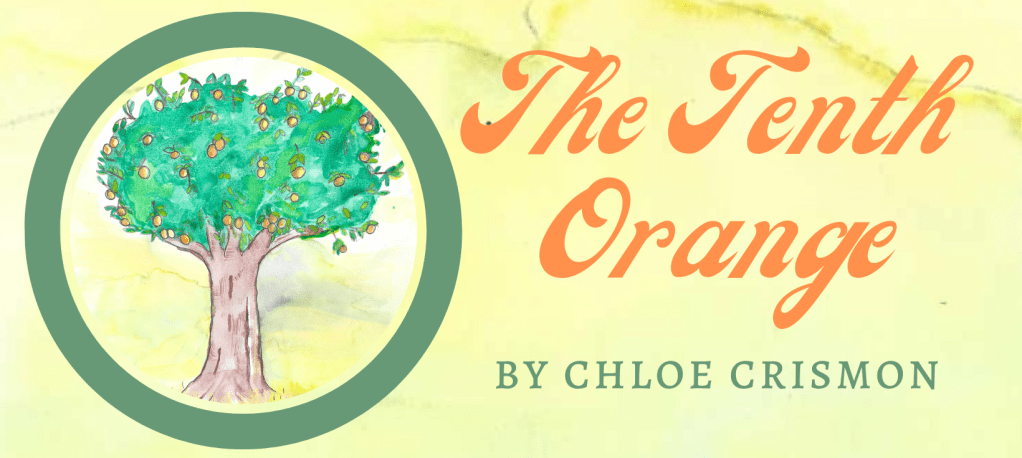
The Tenth Orange

by Chloe Crismon from the June 2022 issue of The Compass

When I was a little girl, I would spend every day of my summer playing with my cousins in Grandpa’s Orchard.

The orchard was filled with row after row of citrus trees. Grapefruits would grow larger than my head, mandarin oranges smaller than my fist, lemons more sour than candy, and tangelos sweeter than sugar.

In springtime the softest blossoms would cover all the trees, with petals whiter than snow. They smelled of that first cut through an orange’s peel.

Grandpa was very direct when he told us not to climb the trees or pick the flowers. “These flowers will become fruit if they stay on the tree.”

We watched from the ground as some blossoms survived the strong wind while others fell, anyway. The flowers drifted in the breeze, landing by our toes. If you were lucky, you could catch one as it fell.

As spring moved on, the petals withered and fell from the trees while the stems stayed strong. In the middle of the flower, where the bees like to go, a small green ball formed.

Daddy would lift me on his shoulder so that I could see, “That is the orange!”

Springtime was gone when the cool clouded mornings became hot blazed days. The sun rose earlier and set later. All the while, the tiny green orbs grew slightly bigger each day.

One cousin discovered that the green oranges weren’t very sweet to eat, but they were hard enough to throw. They would leave bruises on our backs and sides.

When Grandpa learned what was happening, he would yell to the heavens, saying, “Don’t touch my fruit!”

We stood in a line while our parents watched their father teach us the same lesson they learned when they were little. “If you pull all the fruit off the tree before it’s ripe, it will never finish growing. You have wasted so much fruit!” The ground was covered with broken green citrus.

He made us promise not to touch the fruit or we wouldn’t be allowed to play in the orchard anymore. With tear streamed faces, we agreed and said we were sorry.

Summer became hotter each day and scorpions climbed the trees, so our play time was moved to the pool. Splashing to make waves, we soon forgot about the growing fruit.

School started, and the heat held on, even after Halloween. Like the sudden change of petals being on the tree, then on the ground, the warmth faded. The sun rose after breakfast and set before dinner.

During Thanksgiving, I saw the most amazing thing: some of the green fruits were turning yellow, and others were turning orange.

“It’s time to pick the fruit!” Grandma said with excitement. She and Grandpa lined up the baskets while their children and grandchildren began picking the citrus.

Picking oranges was fun to do. I practiced my counting, but only to ten, as Grandma taught me something very important. “Every tenth orange must be placed in the tenth basket. The first nine are ours to keep. The tenth orange is the Lord’s orange.”

Each family was able to take a basket home while the tenth one was given away in the driveway. We would help tie up the fruit in old grocery bags and whoever wanted to take one could. All the while, the older cousins would run the lemonade stand. Grandma reminded them, “The tenth lemon is the Lord’s lemon, so be sure to save all the money you make from each tenth cup so that we can give it to the church.”

Christmas was just around the corner, but still there was work to do. Rotting forgotten fruit brought flies to the orchard, so we helped Grandpa pick it all up off the ground and throw it away.

After the cleaning was finished, the trees were ready to be fed. Overnight, our own ocean appeared. We played in the irrigation water until dark. Every tree was like a floating island in the mirror sea.

Each morning, with orange juice fresh from the freezer, Mommy would say, “Aren’t you proud of all the hard work you did?” With a smile, she added, “It will be fun to help again next year.”

Subscribe to The Compass

Follow us on Facebook

Posted in June 2022, The Compass Issues 2022 | Leave a comment

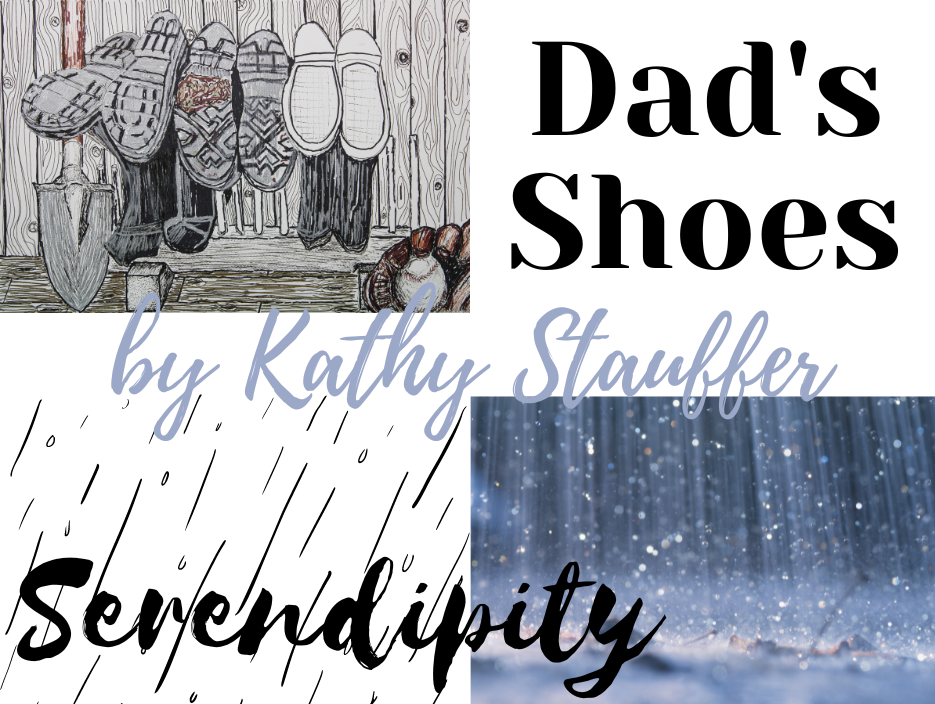
Dad’s Shoes & Serendipity

by Kathy Stauffer, from the June 2022 issue of The Compass

Dad’s Shoes

I went to visit my father a few years ago. Mom had recently passed, and he was doing well in an assisted living environment. In his 90s, he was mentally active, interested in what was going on in the world, wanted up-dates on the grandchildren, and especially liked to visit about farming. We often would settle him in a car and take him for the ten-mile ride to the family farm. He would check out the fields, enjoy the clouds, and reminisce.

The days of his wandering in a meandering, but purposeful journey from corn crib to barn to hog lot to machine shed were over. However, my brothers and I knew his footprints were all over the farm. He had left his mark in the toolshed, in the fields swaying with corn and beans, in the yard where my brothers, Dad, and I played softball every day after summer lunch. His tracks were in the grove surrounding the farmhouse, under the apple trees, and down the quarter-mile lane and back.

He often wore boots to protect his shoes from the messy areas of the farm—rain or shine. But since his move into town, he chose black leather shoes with two Velcro straps, easy to take on and off. I had paid little attention to them, except on that particular day, when we sat side by side for our visit, I noticed them. They were exactly like mine.

I had to laugh. Although I think I’m “with it” as far as fashion is concerned, in my corner of the world, there it was. I had shoes on just like my 90+ year old father: comfortable, worthy shoes. I’ll never know what it was really like to walk in my dad’s shoes: fighting in WW II, raising six children on an average-sized farm, serving on various boards, and never missing a Sunday at church.

Dad is no longer with us, but if I could have a measure of his love for God, of his spirituality; if I could but walk in shoes similar to his, just for this, I would be thankful.

Serendipity

Cemented to this place of hiding

He racks his brain for resolutions.

Bystanders look up; storm clouds throw shadows.

With lightning bolt and thunder slap

The firmament opens; torrents drench the streets.

Passersby scurry for shelter, protection.

For most, the storm poses a problem.

For him, it carries a solution.

He pushes the grate aside,

Covers his face with his cloak,

…and skates the flooded streets to freedom.

Kathleen Stauffer writes Christian suspense fiction available on amazon.com and Barnes and Noble online. You can reach Kathy at kathystauffer@hotmail.com.

Subscribe to The Compass

Follow us on Facebook

Posted in June 2022, The Compass Issues 2022 | Leave a comment

The Constitution—America’s Greatest Export!

by Joseph M. Nunes, from the June 2022 Issue of The Compass

For decades, generations of Americans were raised with the idea of American exceptionalism. And, in truth, the United States of America is exceptional. Yes, there were flaws from the beginning and throughout its history, but it is the greatest nation on earth by any reasonable yardstick. This exceptionalism is rooted in the founding documents: the Declaration of Independence and the Constitution of the United States of America. Before taking a deeper look at these two documents, they should be put into the proper historical context so we can understand what makes them so great.

If you were to gather a group of men in America in 1756 (twenty years before the Declaration of Independence), the group would have consisted primarily of religious leaders. With national sovereignty being rooted across the Atlantic in England, communities looked to clerics for guidance and that guidance came largely from the Holy Bible.

If you were to gather a group of men in America in 1807 (twenty years after the Constitutional Convention), the group would have consisted largely of inventors and explorers. It was the era of discovery. The west was opening up to people who wanted to spread their wings into new, untamed lands in their pursuit of happiness and prosperity. Meanwhile, new technologies were multiplying the efforts of man in areas like farming, transportation, and communication in ways never imagined just decades earlier.

But the intervening years between the age of religious dominance and the age of discovery saw a rise of young men educated in law, politics, oratory, and statesmanship with a few elderly sages to provide a guiding hand. It was really a unique period that has not been replicated prior to or since. With respect to forming a government, this was a gathering of minds unlike any other in the history of the world.

Those founding documents would have looked very different if they were written in those proximate generations of our nation’s birthing. Men twenty years prior to that time lacked the education, experience, and interest to create an entirely new form of government unlike any seen on earth ever before. Men twenty years later had other pursuits to occupy their hearts and their resources.

So, what is it about these two documents that changed the world? What are they and what influence have they had?

The Declaration of Independence was not only a litany of grievances against England and King George III specifically, but, even more significantly, it was a vision statement. It advocated for complete independence from Great Britain stating that the colonies not only had a cause to seek the severance of all former ties but that they had a divine right, even an obligation, to stand up and take their equal place among the nations of the earth. This was certainly a bold vision. The idea of freedom was so essential that the authors invoked deity in various forms of address four separate times, including their trust and “firm reliance on the protection of divine providence.”

This vision statement advocated for the equality of men, inalienable rights, consent of the governed, and for the right of the people to abolish governments that egregiously abuse their power. In 1776, these were startling and outlandish viewpoints that even many colonists did not fully support. But this declaration provided a set of principles that galvanized those who chose to risk lives, fortunes, and honor to see them achieved in a united cause to throw off tyranny in pursuit of individual freedom.

In truth, the Declaration was rhetoric—essential rhetoric—but it provided no guidance about forming a government. It provided no military strategy. It advocated for, but did not provide, rights to the population. It was a “Call to Action!” It heralded a new society in which liberty could abound and citizens could obtain the dreams they were willing to pursue.

It became a rallying cry to the world which still resonates in the hearts of men everywhere. For 250 years revolutions have begun, wars have been fought, and new nations have arisen in the name of liberty. The Declaration of Independence was the visionary seedling that grew into a forest of increasing freedom throughout the world.

On the other hand, the Constitution (outside of a very brief preamble) is practical, almost clinical, in succinctly defining the rights, privileges, responsibilities, and obligations of citizens and branches of government, both horizontally and vertically. In doing so, it intentionally created an inherent opposition between all these parties in order to prevent any single entity from exercising its own tyranny over the others. This system of checks and balances created a tenuous equilibrium unique to the United States, but now replicated throughout the world.

The Constitution remains America’s greatest export. Today, every nation on earth except three, has a form of constitutional government modeled at least in part after the United States Constitution. The three that don’t have a constitutional government (Israel, United Kingdom, and New Zealand), do have strong constitutional principles, but have not collected them into a single document (see Mark Tushnet, “Constitution,” in Michel Rosenfeld and Andras Sajo, eds., The Oxford Handbook of Comparative Constitutional Law (2012), 222).

In the Bible, the prophet Isaiah is best known for his Messianic prophecies, but he also had much to say about this day and age. In one verse, he teaches that “out of Zion shall go forth the law.” In scripture, Zion (or Sion) is almost always used to denote a place of refuge. Is there any place on earth that is a place of refuge more than the United States of America? People from all nations flock to this country in their pursuit of freedom. It is possible, even likely, that the Constitution of the United States is, at least in part, is a fulfillment of the ancient prophecy given by Isaiah more than 2,500 years earlier. (Isaiah 2:3.)

Two documents—written by men particularly educated and trained to be capable of such a task and perhaps in fulfillment of ancient scripture—still have the power to change the world today. We cannot turn our backs on the rhetoric that inspires all of us as we chase freedom. Nor can we reject the principles and practices of good government that puts first the rights and privileges of citizens. It is up to us to safeguard them for not only do we have rights and privileges; we have duties, responsibilities, and obligations to each other and to future generations.

Posted in June 2022, The Compass Issues 2022 | Leave a comment

Republic or Democracy—Does it Matter?

from the June 2022 Issue of The Compass

A teenage boy asked his father about America’s government. “Dad, what kind of government do we have? In school, our textbook says we have a democracy. Our teacher says we have a democracy, and the other day a news station said the same thing. Is that right?”

No. That is not correct. We have a constitutional republic.

How often have you heard influential people in the media, entertainment industry, business, sports, and government refer to our system of government as a democracy? Isn’t that a good thing?

To correctly answer the question, one needs to define the terms democracy, republic, and democratic processes. Reviewing America’s history helps to understand these terms and processes.

A democracy is a form of government where there is mass participation by the people in the writing of laws and the management of the affairs of the country—even the daily decisions of the country’s business.

A republic consists of independent units, provinces, or states. These states then elect representatives on many distinct levels to write laws and conduct the business of the country. The people are not involved in the day-to-day operations.

A democratic process involves a group of citizens who vote for a representative or referendum, usually a one person, one vote contest to determine the outcome. Democratic processes can and do exist within a republic such as in mayoral elections where there is mass participation by the people in the election of the town’s mayor and the town council, but then the people take a step back and allow the elected representatives to manage the town. Having democratic processes does not mean the government is a democracy. Not understanding these terms can cause people to incorrectly identity America as a democracy.

A pure democracy is workable in small groups such as families, towns, and congressional districts. Beyond that, there are serious problems with a pure democracy for larger groups. The people, most of whom are working, do not have the time to stay abreast of the issues of the day. Also, the majority soon grows tired of the constant machinations of governing and lose interest, usually leaving the business to a very few. When large numbers are involved with pure democracies, the operation of the people’s business takes on an emotional climate and becomes exceedingly difficult to manage. It becomes extremely difficult to get large numbers of people, from varying ethnic backgrounds and climes to agree on any decision. This proclivity naturally defeats the efficiency of the government.

Furthermore, the remaining few who do manage the day-to-day affairs find they can vote themselves benefits and control the direction of the nation with little regard for the individual. As history has recorded, France’s attempt at a freedom revolution failed because their pure democracy led to anarchy. It took Napoleon Bonaparte as emperor to undo the resulting chaos. Pure democracies are always just one vote away from utter bedlam.

The mechanisms devised by the Founding Fathers to avoid the chaos of a pure democracy come in three primary ways. 1) The division of power through federalism and the Checks and Balances System. This was designed to prevent a consolidation of power at any level or branch of government. 2) The method of choosing representatives, senators, and the president. The people elect congressmen and congresswomen for two years via a pure democratic vote. Senators were originally selected for six years by state legislatures, so the interests of each state could be heard at the national debate and to function as a shock absorber for the emotional nature of zealous individuals. The 17th Amendment (1913) altered the method of electing senators, ultimately upsetting the delicate balance of power between the Federal government, states, and the people. 3) The president is elected to a four-year term by the miracle of the electoral college. This protects the minority from being marginalized by the majority.

In the history of the United States, five presidents have won the presidential election without winning the popular vote, sending a clear signal that a candidate for president must appeal to both large and small states for support. This one procedure alone moderates the work of the government because all sides of any national debate must be heard and acknowledged. Of the electoral college, Alexander Hamilton said in Federalist Paper number 68, “I venture somewhat further; and hesitate not to affirm, that if the manner of it (method of electing the president) be not perfect, it is a least excellent. It unites in an eminent degree all the advantages; the union of which was to be desired.” Mr. Hamilton goes on to say that if elections are properly administered, the electoral college would prevent cabal, intrigue, and corruption. This same concept provides the foundation for our bicameral legislature. The house (voice of the people) can slow the reserved senate and the senate (voice of the states) can slow the more emotional house in questionable bills. For these reasons and others, a pure democracy was soundly rejected in favor of a republic.

What of these Founding Fathers? Were they, as some have recently conjectured, just a bunch of rich white guys trying to grab and maintain power? W. Cleon Skousen, in his book, The Making of America, gives a summary of these Founding Fathers. “These men were notable in their background and training. Two were college presidents, three were or had been college professors, four had studied law in England, thirty-one were in the legal profession with several having been judges. Nine had been born in foreign countries and knew first-hand the abuses of European style rule. Twenty-eight had served in Congress and most had served in state houses. Nineteen or more had served in the Army: seventeen as officers and four on General Washington’s staff.” Some attended church and some did not. There were pioneering country folks, and some educated members of universities. Some had land and some came from frontier poverty. All of them wanted freedom, “liberty for all,” peace, and an opportunity at prosperity. There is no evidence that any of them wanted to control the masses.

What they were aiming for was a government that could both retain democratic processes in the towns, cities, and sovereign states, and use characteristics of a republic in the federal government that had the necessary powers to conduct the business for the nation but avoid the issues of the Greek democracy which lasted only 80 years. They agreed that the only way to accomplish this was through a republic. Finally, it is worth noting that during the great discussions of the Constitutional Convention concerning the form of government they would be creating, establishing a democracy lost! A thorough reading of the Ninth and Tenth Federalist Papers bears this out. They accomplished their goals in the drafting of the United States Constitution we know today.

The Constitution had two main purposes in its construction. First was to protect the rights and freedoms they viewed as coming from their Supreme Being. These are the inalienable rights—meaning they could not be separated from us—to which Jefferson refers in the Declaration of Independence. The second was to create a free environment, both domestically and internationally, to foster and encourage a free and open market where man’s creativity and initiative would be rewarded in what they called the “pursuit of happiness.”

Originally—and intentionally—there were very few responsibilities granted by the Constitution to the federal government. These duties included things like a standing army, a standardized medium of exchange, immigration policy, post roads, and crimes of the high seas. All of these could be classified as either to protect the country or foster economic activity. These kinds of duties would certainly be better managed by a central government rather than for each state to have its own currency requiring currency exchanges between states or for each state to have its own independent standing army.

Furthermore, the Tenth Amendment in the Bill of Rights clearly states that other than the few duties specifically delegated to the central government, all others were the realm of the state and local governments. This was a clear statement that each state had its own sovereignty and that overreach by the central government was neither wanted nor would be tolerated. As stated above, this aspect of vertical separation in our system is called federalism and the horizontal separation of the executive from the legislative from the judicial is the well-known mechanism of the System of Checks and Balances. Both leave unambiguous evidence that the founders wanted to protect the people from government’s historical proclivity towards abuse of power. These protections were intended for all levels of government: federal, state, and local.

Indeed, they all agreed that it should be a republic of sovereign states—more specifically a constitutional republic—and that this form would provide the individualistic and freedom-loving, American people with the most freedom, the most liberty, the best chance for prosperity, and longevity of government.

At the close of the convention, history reports that a woman stopped Benjamin Franklin in the streets of Philadelphia and asked, “Well Mr. Franklin, what kind of government do we have?” To which Mr. Franklin replied, “A republic madam, if you can keep it!” (James McHenry journal.)

John Adams once said, “I must study politics and war, that my sons may have liberty to study mathematics and philosophy. My sons ought to study mathematics and philosophy, geography, natural history and naval architecture, navigation, commerce, and agriculture, to give their children a right to study painting, poetry, music, architecture, statuary, tapestry, and porcelain.” (Letter from John Adams to Abigail Adams, 12 May 1780.)

If I may be so bold as to disagree with the great John Adams. No, Mr. Adams, we must ensure that every generation understands politics and war. We must be conversant about why our Founding Fathers chose to create a constitutional republic rather than a pure democracy. We need to resist the allure of false ideologies that would enslave us with promises of fairness and equity. We need citizens who understand the pitfalls of all forms of collectivist government and how they lead only to poverty and oppression—not freedom and prosperity. No, Mr. Adams, we want all young girls and boys, men and women, to internalize our freedoms and our rights to life, liberty, and the pursuit of happiness.

Long live the Republic!

Publius of Phoenix 

Posted in June 2022 | Leave a comment